Sunday, February 21, 2016

Third Grade African Masks

Third graders learned about African masks, including their traditional materials, makers, and meanings. Masks are used for ceremonial purposes and combined with costumes and dance. They learned about some of the most prevalent characteristics of masks, including zoomorphism, or animal characteristics, and abstractions. First, they sketched their masks, adding color and explaining the specific ceremonial purpose of their mask. Using primarily natural materials such as shells, feathers, and stones, they brought their sketches to life to create these lively 3-D creations. 


"This mask is for good"

"For ceremonies"

"Good luck for farmers and food"


 "Used for making people grateful"


Friday, February 12, 2016

Seventh Grade Social Justice Collages

Social Justice Collages
In the spirit of Romare Bearden

Seventh graders explored the work of Romare Bearden (1911-1988), an African-American artist who worked in collage, oil paint, watercolor, and many other materials.  He created many of his collages as social justice statements during the Civil Rights movement, to celebrate and to make public the arts and culture that was taking place in predomininantly African-American areas such as Harlem. His collages captured both the struggles and the joy that African-American communities experienced during the Civil Rights movement.

Seventh graders chose a social justice topic with which they feel a connection. They used collage materials such as magazines to create their own statement pieces.


Tuesday, February 2, 2016

Eighth Grade Project: Artists of the Great Depression

Hello Eighth Graders, I am excited for you all to explore these incredible artists  of the Great Depression, and I am looking forward to hearing about what you think of them and how they inspire you. Please see the information below to help you with your art and research project.

Artists of the Great Depression

With your group, create a posterboard or a PowerPoint about the artist. Please send all writing components to Erica as a Google Doc for editing before you glue it down: esmiley@moodle.rashi.org

Include:

·      -A piece of artwork inspired by the artist with a 3-4 sentence artist statement
This can be 2-D or 3-D and in any art media of your choice, even something we haven’t covered this year.  It should be clear how the artist has inspired your work. For example, you can use similar subject matter and/ or similar materials. Type and print this.

·      -A one-page typed double-spaced visual analysis of one of the artist’s works
See attached visual analysis guide for details. Don’t worry! This is not as challenging as it seems- you are basically writing about what you see and your reaction to the piece of artwork, and what it is about the artwork that makes you see it that way. 

·      -Two examples of themes or imagery in common with TKAM
These can be bullet-pointed but should be typed.

·      Four examples of significant events in the artist’s life
Plus, date of birth and death should be included. These can be bullet-pointed but should be typed

·      Four items that you imagine might be in the artist’s backpack/suitcase.
These can be listed, drawn, or sculpted from any media you like.


Resources: Any museum website, any PBS documentary and its supporting materials online, any books or articles provided by Erica. Please see Erica to approve any other sources. Please see the art room blog for links to additional resource pages.

Edward Hopper
Nighthawks at the Diner, 1942

Dorothea Lange


Thomas Hart Benton
From "America Today" Mural, 1930-31

Ben Shahn

Poster for Resettlement Administration, 


Monday, January 25, 2016

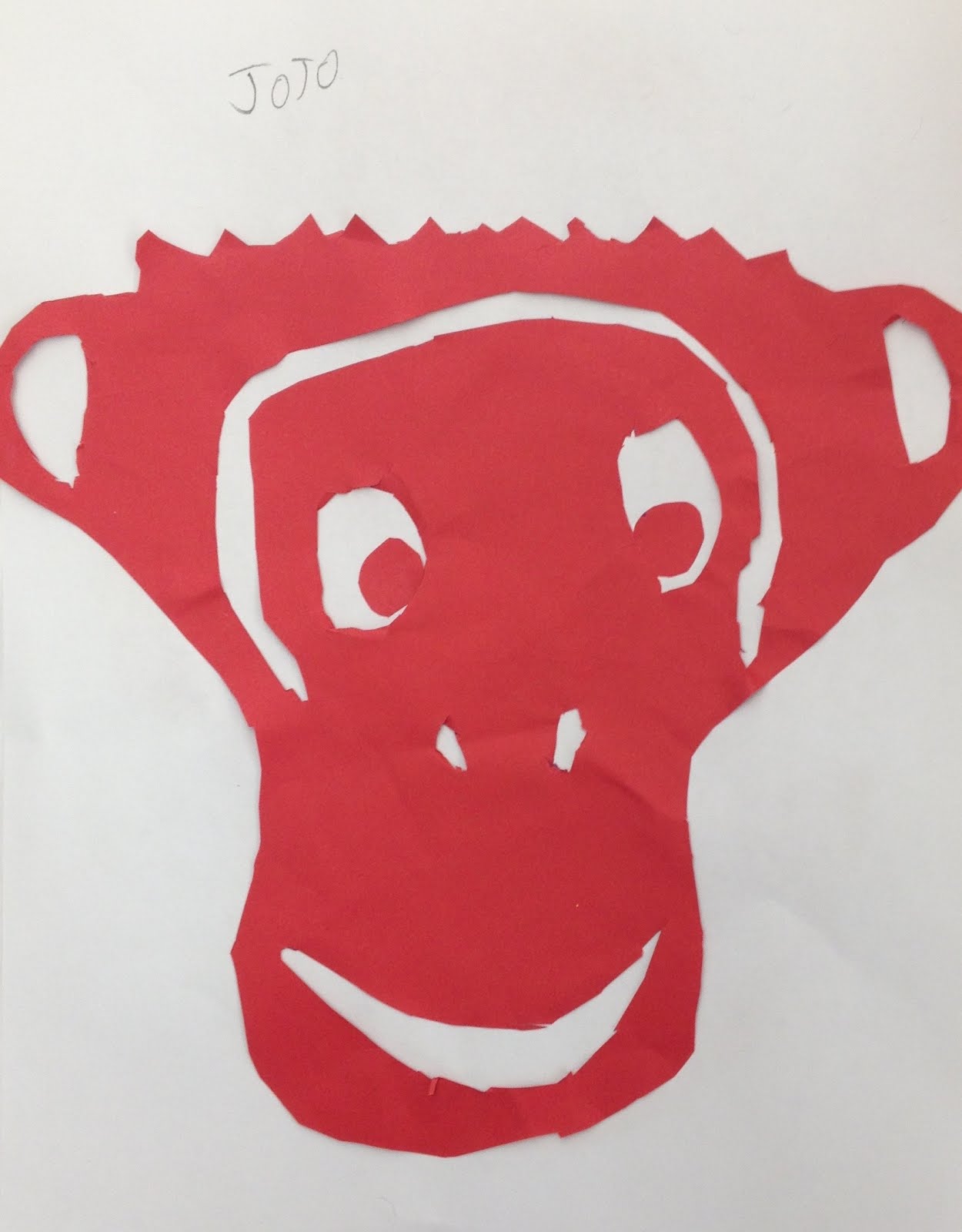
Chinese New Year: Fourth Grade Cut-Paper Monkeys

This is my eleventh year at Rashi, and I have been feeling inspired to refresh the curriculum and try new things.  This year's fourth grade is an energetic and creative class, and they are happy to be my "guinea pigs" as I try some new and awesome projects.

Fourth graders are currently learning about China in Social Studies, so I thought a unit on Chinese New Year would be great for them.  I researched different traditional Chinese art forms, and I was mesmerized by the beautiful and intricate tradition of cut paper. I was also happy to learn that it is the year of the monkey, an animal which I thought would really appeal to a bunch of funny and energetic kids.

First, I introduced the concept of the Chinese Zodiac, or Shengxiao, which translates to "birth likeness." This scheme relates each year to an animal, and those born in that year are reputed to have certain attributes. Then, I showed them traditional cut paper examples. Next, they sketched their monkeys. I xeroxed their sketches onto red paper, and they cut out their shapes. Finally, they glued them onto white paper.


Click here to see which Chinese Zodiac animal you are!


As I mentioned, this is the first time I've done this project.  Though I advised the kids to keep it simple, it was not easy! However, one thing I love about being an art teacher is how differentiated the projects can be.  When they are starting a project, I always remind kids to know themselves and to choose a design that is within their range of ability, but still challenging.  This was a project with a margin for error, and an emphasis on creative problem-solving, which is how I like all the projects to be.

Here are some examples. Personally, I think they're some of the most striking work I've seen this year in the art room!


Tuesday, December 15, 2015

Sixth Grade Perspective Rooms

Sixth graders learned how to draw in one-point perspective. In one-point perspective, all diagonal lines lead to the same point, called the vanishing point. Students designed and created their dream rooms, including furniture, skylights, and home decor.


Seventh Grade Value Studies

Seventh graders spend the first trimester learning about how to use value, or variations of light and darkness, to create special effects in their artwork. Value can be used for contrast, emphasis, or to create 3-dimensional effects, such as with shading. Each student created a contour drawing, or a drawing made only with lines. They used dividing lines to slice up the page and "shatter" their drawing into smaller pieces. Finally, they spent several classes on the task of shading each shape with a graduated value scale. If you look closely at the samples, each and every shape has a complete value scale, from darkest to lightest.


Friday, December 11, 2015

Fifth Grade Maccabee Sculptures


Fifth graders just completed these amazing Maccabee sculptures. The level of detail and care they put into this project was just remarkable to see. They worked hard in class and even came in during their recess time to pour more of their time and energy into their sculptures! They started the project by sketching and brainstorming their Maccabee's backstory.


Ari (above) is a female Maccabee who is a warrior and makes weapons. Her mother's name is Leah and her mother is Saul. One time, she saved another person's life!


Liron is a soldier. He has a sister, parents, and even a girlfriend. His breastplate is made of iron!


This Maccabee above is quite the fashionista- check out her high heels!


Yaakov is a warrior. He has a brother named Benjamin.


This is Malka. Her name means Queen- look at her golden crown! She has a husband and a daughter. She represents female leadership and she helped her town and her people. 


Lazar is a simple salesman who sells food. He is the oldest of six brothers. Poor Lazar got into a fight with a bear once and it almost clawed out his eye.

 
Benyamin is a hunter. He has a brother named Yaakov. Poor Benyamin once broke his arm and his leg at the same time!